
Trenching with a Skid Steer vs. Mini Excavator: Which One Fits Your Job Better?
Both Trenching with a Skid Steer vs Mini Excavator are excellent earthmoving and site-preparation machines. However, contractors and property owners often find themselves wondering which one to use for trenching. Each of these machines is a regular feature on modern job sites, but trenching is one area where their starkly different mechanical philosophies become apparent.
One of them is a fast and multitasking machine, while the other is more like a precise tool for trenching is Skid Steer vs Mini Excavator. Using the wrong one for your particular trenching needs could not only increase your fuel costs but also waste your labor hours and result in a trench that does not comply with the required specifications for utilities or foundations.
You shouldn’t just check machines; you should examine cutting depth, soil conditions, and the environment when choosing between a skid steer and a mini excavator. In fact, a skid steer is often thought of as the “Swiss Army Knife” of the construction industry capable of rapidly changing from a regular bucket to a highly specialized trencher attachment.
However, compared to that, a mini excavator is a very-precisely-designed and highly-effective trenching tool/machine that not only digs very accurately but also does a 360-degree motion which is very useful when working in smaller spaces where a skid steer may have a hard time maneuvering.
This guide is here to help you decide which of these two machines is better for your project by looking at their respective advantages, disadvantages, and key performance indicators for Skid Steer vs Mini Excavator.
Understanding the Mechanics: How Each Machine Trenches
The most basic difference between these two machines is in how they engage with the ground. A skid steer loader when fitted with the trencher attachment usually employs what is known as a “push and pull” or “chain-driven” method.
It is moving linearly, cutting the path as it goes. In comparison, a mini excavator is practically stationary and uses its articulated boom and bucket to do the scooping of the earth. This is an important difference when it comes to what is referred to as the “footprint” the machine leaves at the jobsite.
- Skid Steer Method: Powers the chain-driven trencher that works like a big chainsaw for the soil using a high-flow hydraulic system.
- Mini Excavator Method: Uses the hydraulic breakout force and different sizes of buckets to precisely dig soil to the required depth.
- Maneuverability: For turning, skid steers use a kind of tire or track “skidding,” so they need a little more room for a pivot. Mini excavators, however, are capable of house rotation up to 360 degrees while keeping the tracks planted.
Performance Breakdown: Depth, Speed and Precision
Choosing Trenching with a Skid Steer vs Mini Excavator breaks down to performance, which is not simply about how fast you can dig but rather, how well the trench fulfills its main function.
If installing thin fiber-optic cable, the speed of a skid steer fitted with a specialized attachment may allow it to finish the job way ahead of the excavator. On the flip side, if the task is to make a trench of up to 6 ft deep for a main sewer line, the skid steer won’t be able to reach safely or efficiently the worksite, let alone do the job.
- Digging Depth: Generally speaking, mini excavators can reach depths of 8 to 12 ft, whereas the majority of skid steer trencher attachments max out at 3 to 5 ft.
- Linear Speed: When there are long stretches of shallow soil, a skid steer equipped with a chain trencher is exceptionally quicker than an excavator.
- Precision and Grade: Mini excavators make “on-the-fly” trench depth modifications possible and they can also easily avoid damage underground utility lines during excavation.
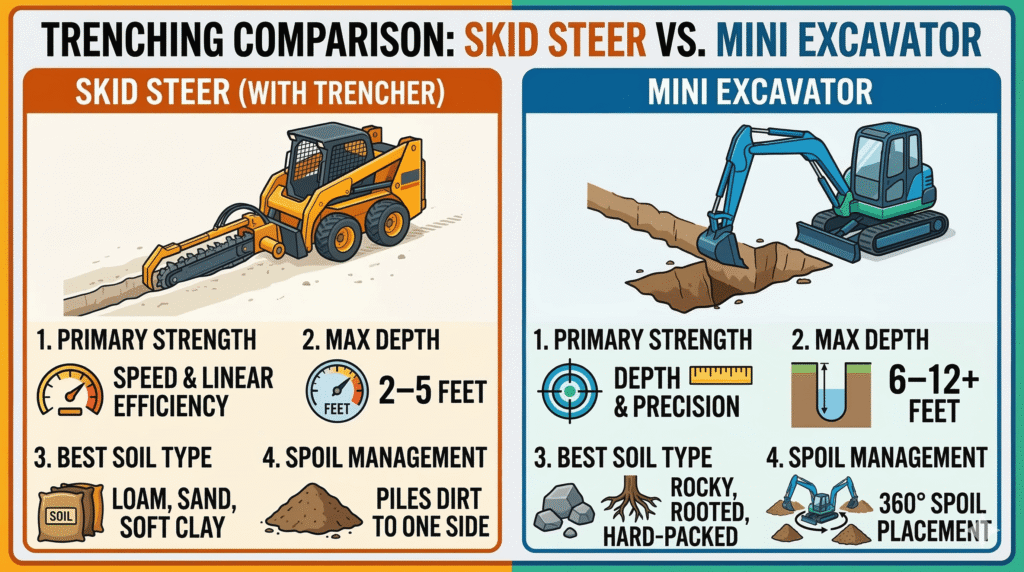
Table: Trenching with a Skid Steer vs Mini Excavator
| Feature | Skid Steer (with Trencher) | Mini Excavator |
| Primary Strength | Speed and linear efficiency | Depth and precision |
| Max Depth | 2–5 Feet | 6–12+ Feet |
| Best Soil Type | Loam, sand, soft clay | Rocky, rooted, or hard-packed |
| Spoil Management | Neatly piles dirt to one side | Allows for 360° spoil placement |
Versatility and Attachment Ecosystem
Perhaps the major appeal of skid steer is it being a multitasking machine rather than simply a trencher. Most of the time, the machine that goes into the ground to dig the trench ends up being the same that hauls the gravel, does the site grading, and loads the truck for disposal. In this aspect, the skid steer is a star performer.
Then again, the mini excavator is also not lacking when it comes to versatility; loaded with a thumb or breaker, it often turns out to be a lifting crane or a demolition tool.
- Switching Tasks: Since skid steers have a universal quick-attach system, moving quickly from trenching to using pallet forks or a grading bucket is quite easy.
- Specialized Digging: Mini excavators are capable of using “V-buckets” for creating drainage shapes and with hydraulic thumbs they can remove large rocks and stumps that would block a chain trencher.
- Surface Impact: Wheeled skid steers have an advantage on pavement with their speed but can damage the turf, whereas mini excavators with rubber tracks distribute weight evenly which makes them more landscape friendly.
Soil Conditions: When the Ground Fights Back
Usually, the soil conditions at your worksite will decide on your Trenching with a Skid Steer vs Mini Excavator choice. Skid steers fitted with chain trenchers are often considered as choking or “binding” when they come across a large rock or thick tree roots.
The fast-moving chain can either kick back or the teeth get damaged. On the other hand, a mini excavator’s large hydraulic breakout force lets it “pry” these obstacles out of the ground, making it a better option for difficult terrain.
- Rocky Ground: In rocky ground, mini excavators continue to be regarded as the best choice especially since the chain would simply be destroyed.
- Wet/Muddy Conditions: The excavator’s non-moving nature mapped against a skid steer that needs to move back and forth, places it at risk of becoming stuck.
- Root Systems: Trenching near the roots of old trees, an excavator can gently remove any exposing roots but a trencher will probably cut them or be unable to take them and it will stop running accordingly.
Cost Analysis: Rental vs. Ownership
In the Trenching with a Skid Steer vs Mini Excavator financial view, you not only look at a daily rental rate but also your fuel costs along with the wear and tear of the teeth and chains as well as the time saved by using the faster machine.
In general, skid steers are lower in purchase price but their trenching specialization attachments cost quite a bit among Skid Steer vs Mini Excavator.
- Operating Costs: These machines are normally run at a high RPM so as to keep the hydraulic flow up for the trencher leading to the consumption of more fuel.
- Maintenance: Compared to the high-wear chains and teeth of a skid steer trencher, mini excavators require fewer replacements of “ground engaging” parts.
- Efficiency: Labor savings alone make the skid steer the winner for that particular task if it completes a 500ft run in 3 hours that an excavator carries out in 8 hours.
Which One Is More Suitable for Your Jobsite?
At the end of the day, the winning Trenching with a Skid Steer vs Mini Excavator goes to the one which best fits the “Scope of Work.” For example, if you are a utility contractor who is laying miles of fiber or irrigation in open fields, the speed of a skid steer fitted with a trencher is unbeatable.
On the other hand, residential plumbers, foundation contractors, or anyone else working in very tight “zero-turn” environments will find the mini excavator the essential king of the hill.
- Pick a Skid Steer if: Long, shallow, and straight line trenching in soft soil is to be done. Besides this, mulch or gravel material moving capability is also needed.
- Select a Mini Excavator if: The requirement is to dig deeper than 4 feet, handle piping in the process, and deal with heavy rocks and roots.
- The Combination: A number of expert crews bring both – the excavator is used for the “tough spots” and the skid steer for backfilling and material handling.
Frequently Asked Questions: Trenching with a Skid Steer vs Mini Excavator
Can a Skid Steer dig as deep as a Mini Excavator?
Not really. Most skid steer trencher accessories are designed for a maximum depth of 3 to 5 feet. On the other hand, even compact mini excavators can easily dig down to depths of 8 to 12 feet making them the only option when it comes to deep utility or foundation work.
Is a Skid Steer faster at trenching than an Excavator?
Yes, but only under certain conditions. In soft, rock-free soil, a chain trencher on a skid steer can cut a narrow line much faster than an excavator can scoop the material. However, if the ground is rocky or the trench is wide, the excavator will be more efficient.
Will a Skid Steer trencher cut through tree roots?
Small roots should pose no problem to a good chain trencher but thick, woody roots are likely to stall the machine or even break the chain teeth. To deal with heavy root systems, a mini excavator is both safer and more effective.
Which machine is better for working in a small backyard?
A mini excavator is usually a better option for close quarters work. Since its cabin can rotate 360 degrees, it can do all the digging and dumping without moving its tracks. A skid steer, on the other hand, will need space to go forward and backward or to pivot its entire frame.
Do I need a high-flow hydraulic system to use a trencher on my skid steer?
Some small trenchers do run on standard hydraulic flow, but “High-Flow” hydraulics are strongly recommended for trenching; it provides the high torque required to cut through even the toughest soils without the chain stalling.
Which machine causes less damage to the grass?
Mini excavators are generally less aggressive on turf due to the fact that the machine stays in one position during digging so no ground “scuffing” occurs. Skid steers, especially wheeled ones, tend to tear up the grass when they turn or “skid.”
Can I use a mini excavator to backfill a trench?
Mini excavators are equipped with a bucket or a front-mounted dozer blade, hence, they can be used for backfilling. On the contrary, a skid steer is much faster when it comes to moving large piles of earth and finishing off the surface after the trench has been filled.
