
Beyond the Blade: Essential Skid Steer Salt Spreader Attachments for Ice Control
The essence of getting rid of snow and ice on the roads in winter should be more than just using a typical plow. Snow blades alone can move huge amounts of snow but at best, they leave a thin layer of ice that can only be discarded by chemical de-icing. That is when Skid Steer Salt Spreader attachments come in to rescue winter maintenance.
Using a spreader in your machinery means that your loader becomes a one-stop-shop for ice management, thus effectively preventing accidents to both pedestrians and drivers. Let’s dive deep in to learn the prominence of Steer Salt Spreader attachments.
A Skid Steer Salt Spreader Attachments Is a Must-have for Every Winter Professional
The main reason a skid steer salt spreader is very handy is because of its ability to spread the chemical ice-melters evenly to the ground. A skid-steer-mounted spreader gets you home to perfect your lawn very fast when used alone, unlike manual spreading or spreading with an additional truck.
These skid steer salt spreader attachments are designed ready to take on very tough and corrosive materials and at the same time, a very pleasing consistent spread pattern is achieved thus the situation of “clumping” gets avoided which noise equipments of lesser quality cause.
- High Ability to Quickly Salt Hard-to-Reach Areas: With a skid steer, you can quickly salt areas where a truck can’t go just with a simple turn.
- Salt Spreading and Snow Removal by a Single Operator: A single operator is able to clear the snow and then proceed with ice control without having to call for a second crew.
- Fine Ice Control Air Distribution and Minimal Material Waste: You are able to regulate the spread width and volume right from your vehicle cab, and hence, you use the correct amount of material without waste.
Skid Steer Salt Spreader Attachments That Will Be Hot in 2025
Your choice of a Skid Steer Salt Spreader attachments in many respects is a reflection of how big your operation is and the surfaces you mostly work on. Currently, some of the newest attachment models even have self-loading hoppers, which mean you can just scoop salt from a pile as you would when loading a bucket and so no more manual refilling at all.
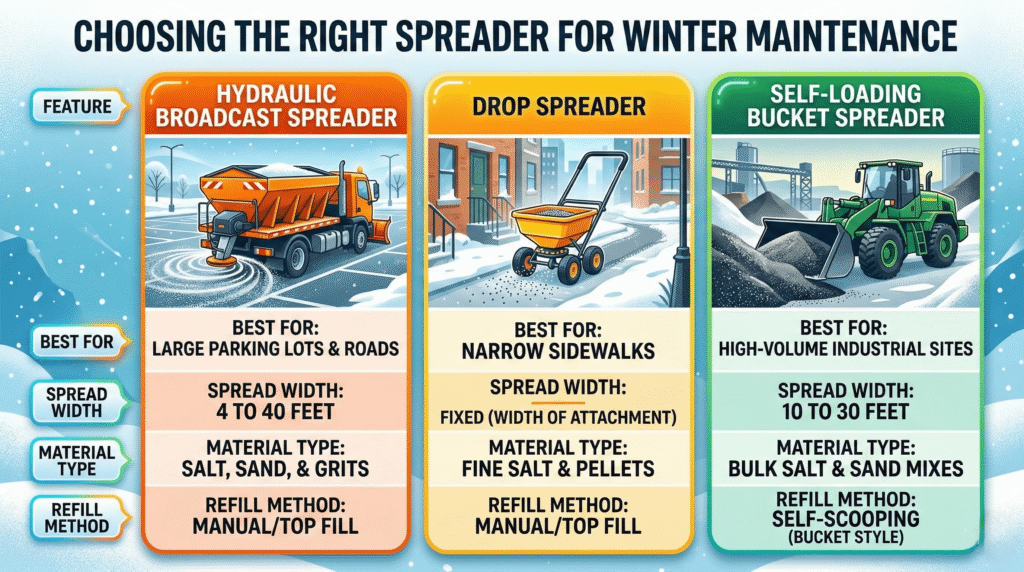
This is a comparative table that clearly shows the features and benefits of different types of spreaders that are currently the most trendy ones on the market.
Table: Skid Steer Salt Spreader Attachments Features
| Feature | Hydraulic Broadcast Spreader | Drop Spreader | Self-Loading Bucket Spreader |
| Best For | Large Parking Lots & Roads | Narrow Sidewalks | High-Volume Industrial Sites |
| Spread Width | 4 to 40 Feet | Fixed (Width of Attachment) | 10 to 30 Feet |
| Material Type | Salt, Sand, & Grits | Fine Salt & Pellets | Bulk Salt & Sand Mixes |
| Refill Method | Manual/Top Fill | Manual/Top Fill | Self-Scooping (Bucket Style) |
- Hydraulic Drive Systems: In most modern and high-end units, the skid steer auxiliary hydraulics drive the spinner, hence the torque remains constant even at freezing temperatures.
- Corrosion-Resistant Materials: To keep your equipment from rust, choose hoppers made of stainless steel or high-density polyethylene.
- Internal Agitators: The main function of these agitators is to ensure uninterrupted flow of salt to the spinner by constantly breaking the hard clumps of salt that have been frozen due to the temperature.
Maximizing Efficiency with the Right Ice Control Strategy
A Skid Steer Salt Spreader attachments are a complete well-rounded strategy is not put into motion alongside its usage, it might not fully be effective. It is during this process of doing a pre-treatment to a surface before a snowstorm that you are actually preventing the formation of ice because the ice will not be able to stick to the pavement therefore, plowing will be quite efficient afterward.
Great professionals also understand that the amount of spread has to be changed in correspondence to the temperature changes, and this is because when it becomes colder you have to apply more of the de-icing chemical in order to get the same effect.
- Equipment calibration: When working, you should first spread salt on a dry surface so that you know exactly how much salt was spread without wasting any. Besides, this exercise prevents you from purchasing excess salt which would have been wasted.
- Use the Right Material: Some ice-melts are incompatible with your spreader; therefore, you should always ensure the equipment’s auger is suitable for the type of salt or grit you want to use.
- Post-Storm Maintenance: In the long run, it’s actually salt that causes rust so keep your Skid Steer Salt Spreader off the salt by always washing it thoroughly after every use so that you can count on your equipment even for the next couple of winters to come.
Advanced Features: Beyond the Basic Hopper
The newest upgrades in Skid Steer Salt Spreader attachments tech involve the incorporation of “Smart” controls and the use of modular systems. A few brands are already giving out vibrator kits as an accessory to their salt spreaders, to eliminate the occurrence of bridging (when salt gets stuck forming a dome shape above the auger).
Besides that, a very important issue was solved – the operator’ visual field – by having the low-profile designs which let the operator see over the hopper, a very important fact for safety when working around heavy traffic areas of commercial buildings or parked cars.
- Dual-Spinner Systems: Certain large-area spreaders are equipped with two spinners to provide very even distribution of material over a 40-foot wide path.
- In-line Speed Control: A digital controller lets the operator control the spinner…
- Sidewalk Kits: It is possible to add optional deflectors which would narrow the spread thus keep all the material on a 3-foot sidewalk and prevent the grass next to the sidewalk from getting salt.
FAQ’s – Skid Steer Salt Spreader Attachments
Can I also use a skid steer salt spreader attachments for sand?
Indeed, neat and clean Skid Steer Salt Spreader attachments are supposed to spread different kinds of materials apart from one another. In fact, during the season when the spreader is not being used to spread salt, it can be used for the distribution of seed or fertilizer as well as salt/sand mixes, dry sand, etc. Sand differs only in that if it is going to work smoothly a very powerful agitator has to be there that will guarantee that no clogging will occur.
How much salt does a typical skid steer spreader hold?
Depending on the size of the unit, there could be a significant difference in the amount of materials to be expected. For example, one that is meant only for sidewalks may typically hold from 5 to 8 cubic feet, whereas a hopper for industrial use with very large capacity can hold as much as 1/2 or even 3/4 cubic yards.
Do I need high-flow hydraulics for a salt spreader?
There is no need for flow rates higher than those you would normally get out of standard hydraulics for the great majority of Skid Steer Salt Spreader add-ons. Pumps providing as little as 10 to 20 GPM should be sufficient to power both the motor of the spinner and the agitator.
How do I prevent salt from clumping inside the hopper?
Storing salt in a dry and covered place away from the elements is the surest way to keep the salt loose and prevent it from becoming a solid rock. No matter if the salt is that dry yet it was just exposed to some moisture and you always keep it indoors, there is mechanical help in the salt spreader in the form of an agitator or vibrator that breaks the clumps so that you do not have to be concerned about unfreezing the salt.
What is the difference between a broadcast spreader and a drop spreader?
The two mainly differ in that a broadcast spreader works by means of a spinning disk which enables it to “throw” its contents like salt, ice-melt, etc. over a rather wide radius (roughly up to 40 ft.) While a drop spreader, as its name suggests, drops and deposits the material right under it hence making it more accurate and therefore is preferred in narrow areas such as sidewalks where you wouldn’t want the salts to extend to the grass.
Is a self-loading salt spreader worth the extra cost?
A self-loading Skid Steer Salt Spreader attachments are so convenient to use when working alone that there is no longer any need to get help – it is basically the best in such situations. With it, you more or less have a bucket with you all the time and can do the reloading even while being seated in the cab.
How do I maintain my salt spreader to prevent rust?
Removing all the salt residues by thoroughly rinsing the entire attachment with fresh tap water is the best and the simplest way to fight corrosion. You should be very careful and make sure to clean even the smallest parts of the attachment properly including hydraulic fittings and the spinner motor. If you want to go the extra mile at the end of the season, you should apply a rust-preventive spray as well.
