
How Brush Grapple Transform Skid Loaders into Debris Management Pros
Specialized attachments have significantly transformed the facets of construction, landscaping, and forestry in modern times. Among them, the skid steer brush grapple is a remarkable innovation that has revolutionized the industry. In comparison, a standard bucket is only capable of simple scooping and dumping, while a brush grapple gives a skid steer loader the capability to grab, pinch, and pull, thus changing a compact machine into an instrument of precision for debris management.
Whether you are cleaning up a disaster area, preparing the land for a new building, or maintaining a large farm, the first step towards optimized operational efficiency is to comprehend how these attachments work.
Brush grapples combine the force of hydraulics with the mechanical grip of steel tines to address the problem of “loose material” which has always hampered the productivity of traditional loaders. Instead of repeatedly pushing brush into piles and then losing half of it during transport, the same amount of brush can now be secured for the operator with a sufficiently strong clamp. The present text delves into how powerful these tools are and how they can help you get the best out of your loader.
Understanding the Mechanics: Why Grapples Outperform Buckets
Essentially, a brush grapple is a piece of equipment meant to pick up the “unpickable.” Conventional buckets are good only for granular materials such as dirt or gravel; they are not suitable for handling irregular shapes such as twisted branches, jagged roots, or big stumps.
The lower tines serve as a rake while the upper hydraulic jaws clamp in the brush grapple’s dual-mechanism system, thus solving the problem through dual mechanisms.
- Hydraulic Clamping Force: The dual cylinders allow the jaws to apply independent pressure on uneven loads, so the grip remains firm even if one side of the load is thicker than the other.
- Open-Floor Design: Brushes grapples have spaced tines through which dirt, sand, and small rocks can sift, unlike solid buckets, so, the result is a cleaner load of debris.
- Superior Visibility: Operator’s visibility is greatly improved because the grapple’s skeletal structure allows for seeing through the attachment and hence it is easy to slip the tines precisely under a root or log.
Versatility in Action: Where Brush Grapples Excel
The brush grapple is an invention of high utility not confined to any single domain only. Its usefulness covers a wide range of occupations from municipal maintenance to management of private lands. The capability to lift and securely carry large and bulky articles that otherwise would fall off the machine drastically cuts down the time wasted on “clean-up after the clean-up.”
- Land Clearing and Forestry: Removal of unwanted shrubs from the land and gathering of down trees and wind-fallen timber is made easy, the tines can penetrate the ground to pull up root systems.
- Storm and Disaster Cleanup: After windstorms or floods debris is often a mixture of wood and building material; picking through this mess is no problem for the grapple.
- Agricultural Utility: Large quantities of loose hay, manure, or orchard trimmings can be moved faster once you have the ability to grab the pieces rather than just shoving the pile.
Comparative Analysis: Choosing Your Professional Attachment
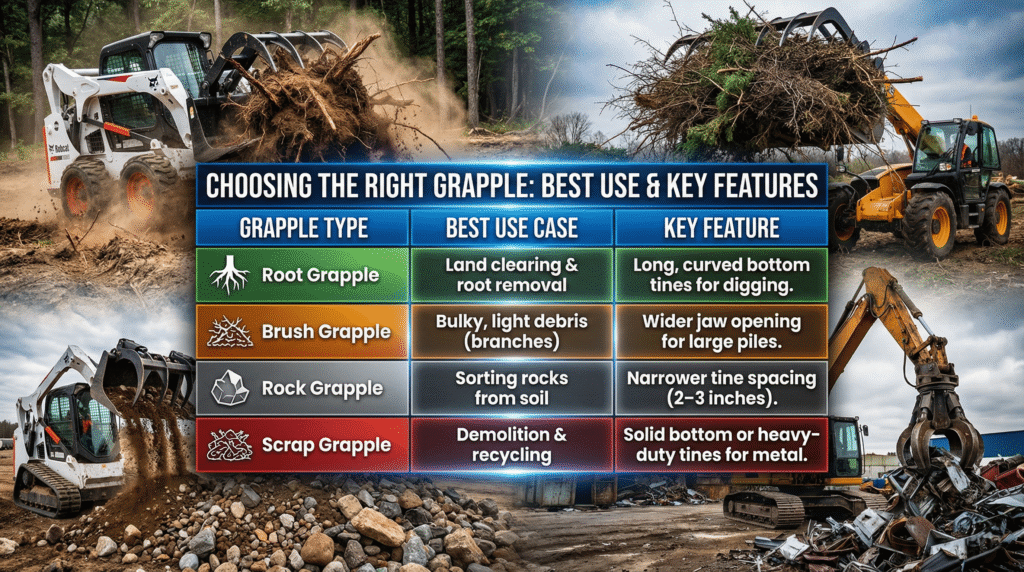
Different types of grapples have different characteristics. It is possible for you to require a special model depending on what exactly your debris removal involves. The following table gives you insight into the variety of grapples you are likely to call upon in a professional setting.
| Grapple Type | Best Use Case | Key Feature |
| Root Grapple | Land clearing & root removal | Long, curved bottom tines for digging. |
| Brush Grapple | Bulky, light debris (branches) | Wider jaw opening for large piles. |
| Rock Grapple | Sorting rocks from soil | Narrower tine spacing (2–3 inches). |
| Scrap Grapple | Demolition & recycling | Solid bottom or heavy-duty tines for metal. |
Maximizing Efficiency: Pro-Tips for Debris Management
To take it to the next level of a “debris management pro,” simply having the right tools in your hands is not enough.
You need to advance your skills to the point where not only is your output increased, but also the lifecycle of your tool is maximized. The secret to efficiency lies in the manner of your approach to the heap and the running condition of your machine.
- Strategic Piling: Always try to get a “deep bite” by tackling the debris where branches are most tangled which is also a way of ensuring that you get the entire load secured in one go.
- Back-Dragging Technique: Turning the grapple over to drag the back part is useful when you want to level the ground or gather loose debris into a central pile for easy pick-up.
- Hydraulic Awareness: When the jaws are closed, never try to “ram” a pile with them; instead, open the jaws and drive into the pile’s base, then use the hydraulics to clamp the material tightly.
Durability and Maintenance: Keeping Your Pro Status
Equipment at the professional-grade level necessitates care of the same nature. Since brush grapples are exposed to high torque and impact, neglecting maintenance will result in breakdowns that are very expensive to rectify. Apart from the safety aspect, a well-kept grapple is a source of greater profit.
- Daily Lubrication: Lubricate grease fittings and other pivot surfaces at least once every 8 to 10 hours of use to prevent metal- to-metal wear which ultimately leads to misalignment of the jaws.
- Structural Inspections: Any time after doing some heavy land clearing, it is a good habit to check for bent tines or cracks around the welds.
- Hose Protection: Make sure hydraulic hoses are installed correctly, and use hose sleeves to keep them safe from damage when the arms are at full lift.
FAQ’s – Skid Steer Brush Grapple Attachments
What is the difference between a root grapple and a brush grapple?
It is true that both features hydraulic jaws, but a root grapple has longer and more aggressive tines allowing it to penetrate deeper into the soil for root extraction. Generally, a brush grapple is made for gathering heavy, bulky surface debris like branches and bushes with a wider jaw opening.
Can I use a brush grapple on a mini skid steer?
Sure, these attachments are made mini as well. The foremost criteria of your mini loader’s ROC should be the attachment’s weight and the load you anticipate.
How much hydraulic flow does a brush grapple require?
Most brush grapples rely on the standard-flow hydraulics of the machines they are mounted on. You rarely have to install a “high-flow” system for them as the hydraulic cylinders need just the right amount of power to open and close the jaws and not for running the motor continuously.
Will a brush grapple damage my lawn?
Since the tines are pointed in the grapple, turf will be easily affected by them if you are not sufficiently careful when using them. Operators should let the attachment “float” just above the grass to reduce damage or employ the tines-closed, back-dragging technique.
What size grapple do I need for my skid steer?
You can always choose a grapple slightly wider than your machine in general. This way, your tires or tracks will be well protected from the debris you are driving into. The commonly available sizes range from 60 to 84 inches.
Is a dual-jaw grapple better than a single-jaw?
The dual-jaw (also called split-top) grapple is very beneficial for handling irregularly shaped loads. This is the case because each jaw is controlled by a separate cylinder and thus they are able to clamp down on different heights of debris at the same time, thereby giving a much more secure grasp on uneven piles.
Can a brush grapple be used for demolition?
Sure, but for heavy work you will have a better chance of success if you use a specialized scrap or demolition grapple with thicker tines and reinforced steel.
The Final Verdict: Why It’s a Must-Have Investment
Choosing to place a brush grapple skid steer at the top of your purchase list for new tools is certainly one of the smartest decisions regarding your equipment you’ve ever made. On one hand, great reduction of manual labor suffices for an operator to single-handedly do the tasks usually handled by a crew of five people on the ground. The maturation of your machine into a “debris management pro” is tantamount to stepping into a bigger project market, finishing your works faster, and introducing a safer working environment.
When you visit skidsteerloader.online, you are basically not viewing tools but the potential of your business to grow in terms of productivity. Today, switch from a mere bucket to a professional grapple and feel the field difference a specialized attachment makes.
